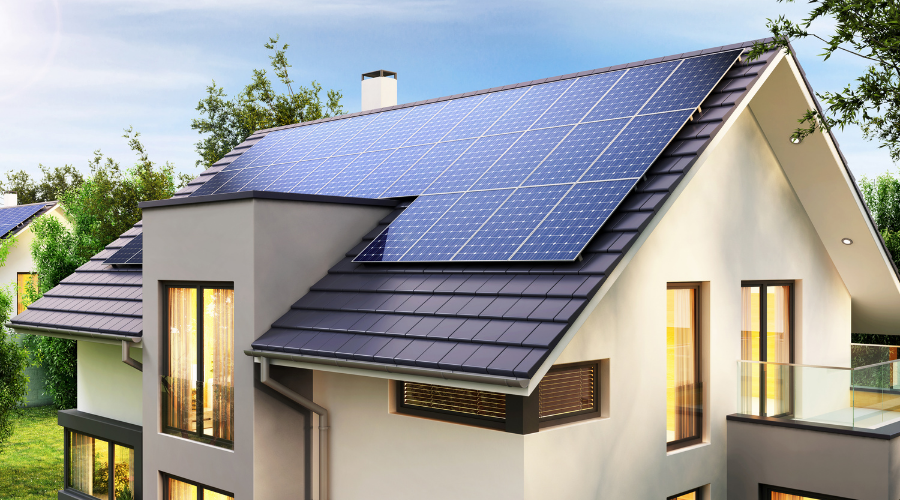

According to a Forbes Home survey of 1,000 homeowners who installed solar panels within the past five years, their solar panels save them close to $70 per month on average. Paired with being a clean energy source and potentially reducing reliance on the grid, there are a lot of compelling solar energy advantages. But, for a complete picture, it’s important to consider both the pros and cons of solar panels.
If you are considering solar panels, we’ll help you look at the solar energy benefits and drawbacks—complete with expert input, real customer insights and a look at the current conditions of the ever-changing solar energy market.
Solar Energy Pros
Homeowners can harness solar energy through solar panels or solar roof tiles to cut down or eliminate their electricity costs. This can result in cleaner energy production and lower costs for decades to come, says Ben Zook, a solar panel system designer and owner of Belmont Solar in Pennsylvania. “Using solar power is a lot like planting a tree,” Zook tells Forbes Home. “The saying is, ‘The best time was 20 years ago. The second-best time is today.’”
Here’s a closer look at solar energy advantages.
Environmental Benefits
At its essential level, solar energy is a renewable energy source—meaning the sun provides an endless and replenishing energy source, which stands in contrast to fossil fuels. These environmental benefits were a motivating factor for 36% of people who responded to our survey.
According to an independent review from the U.S. Energy Information Administration, manufacturing solar panels involves some energy-intensive steps and risks. However, the review summarizes that using solar energy still has an overall positive impact compared to “other energy sources that have larger effects on the environment.”
Energy Bill Savings
The leading reason that people who responded to our survey said they decided to install solar panels was to achieve lower energy bills, with 64% of customers citing that as the top motivation. Not only did customers report saving $68.80 per month on average, but 29% of customers saved more than $90 each month.
Given that solar panels can be reasonably expected to efficiently produce energy for 25 years—the standard production warranty period of many brands—that translates to savings of more than $20,600 through the life span of solar panels. Solar expert Zook tells Forbes Home that real energy bill savings are likely even greater based on expectations for inflation, saying that costs of future energy production can make a big difference.
Costs Have Gone Down Over the Years
As is often the case with technology, solar panels have become more efficient and less expensive through the years—meaning the average homeowner can get even more bang for their buck. There is even a term for this: Swanson’s Law, which says that the price of solar photovoltaic modules decreases about 20% every time the cumulative shipped volume doubles.
Current incentives also effectively lower the costs of solar panels. These can vary by state, county or city. The biggest and most widespread incentive is the federal government’s Residential Clean Energy Credit, which allows a new solar panel owner to get a tax credit in the amount of 30% of the total material and installation costs. For example, if solar panels cost $20,000, the homeowner’s tax bill can be lowered by $6,000 the following year.
Due to legislation passed in July 2025, funding for this program is now set to end after 2025. To be eligible, customers must install and activate their solar panels by December 31, 2025.
*The IRS website has not reflected the funding change as of September 2025.
Increased Home Value
Installing solar panels can instantly give your home value a boost. There is one caveat, Remi Akinwonmi, a solar energy expert with the American Solar Energy Society, tells Forbes Home: “When the system is owned outright, it adds value to the home, [though] less than the initial capital cost.” On the other hand, he says installing solar panels that are leased or through a purchase power agreement can be a “turn off” for potential buyers.
With owned solar panels, the National Renewable Energy Lab estimates home value increases by $20 for every $1 in annual savings to energy bills. Using the approximately $70 per month ($840 per year) savings expressed in our survey, that translates to increasing a home’s value by $16,800.
Solar Energy Cons
Despite the environmental, long-term savings and other benefits of adopting solar energy, installing solar panels or solar shingles is not right for everyone. “Many factors are involved in determining who solar is best suited for,” solar installer Zook says, adding that some homeowners may not be as good of candidates based on their location, finances or general timing.
Upfront Costs Can Be Steep
Based on our research and the latest data, installing solar panels costs about $7,700 on the low end, and can go up to more than $34,000. A range of $16,600 to $20,500 is common for typical 6.5 kW systems. Our survey shows an even higher average of $25,976 among the 1,000 customers surveyed who installed solar panels within the past five years. In other words, installing solar panels is a significant investment.
While different types of financing are often available, these can add to the total costs or limit customers’ abilities to use incentives. For most incentives, the solar panels must be owned or financed, not leased or used through a purchase power agreement.
Storage Can Also Add to Your Costs
For 31% of survey respondents, having backup or emergency power during outages was a leading motivator for installing solar panels. To tap into saved solar power during an outage, however, customers also need a solar battery. The average solar battery with 10 kilowatt-hours (kWh) of storage costs close to $4,000, but costs could be closer to $9,000. For a battery that’s truly capable of supporting off-grid energy independence, customers are looking at more than $15,000.
Source: Forbes.com ~ By: Emily Glover ~ Image: Canva pro
